Refresh rate and response time are two of the most important display specifications in sim racing. They influence how smoothly motion appears on screen, how quickly visual information updates, and how responsive the driving experience feels during high-speed racing situations.
This article explains how refresh rates and response times affect sim racing performance, when higher specifications matter, and how racers can balance performance with budget when choosing a display.
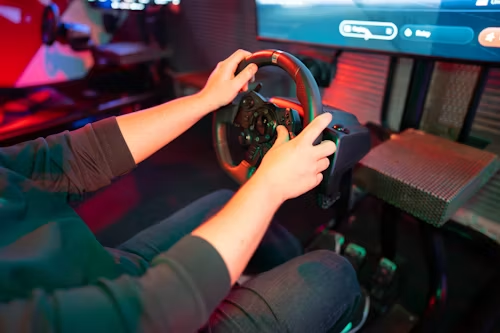
Why Display Speed Matters In Sim Racing?
Sim racing places unique demands on a display because vehicles move rapidly through detailed environments where split-second decisions can influence race outcomes.
Many competitive racers evaluate quality and performance of monitors for sim racing by focusing on motion handling, visual responsiveness, and image stability rather than image sharpness alone.
Motion Clarity During High-Speed Racing
When approaching a corner at speed, the driver must process visual information quickly and accurately. A display that presents motion smoothly helps maintain focus and reduces visual distractions.
Benefits of improved motion clarity include:
- Easier corner identification
- Better braking point visibility
- Improved vehicle tracking
- Reduced motion blur
- Greater driving confidence
The faster the racing environment changes, the more noticeable these benefits become.
Input Lag And Driver Reactions
Input lag measures the delay between a driver’s action and the corresponding on-screen response.
While steering wheels and computers contribute to overall latency, the display remains an important part of the responsiveness chain. Lower display latency can help create a more connected driving experience.
Display responsiveness becomes even more important when evaluating refresh rates.
Understanding Refresh Rates
Refresh rate refers to how many times a display updates the image every second.
Drivers seeking a best monitor for sim racing for competitive racing setup often prioritize refresh rate because smoother updates make vehicle movement easier to interpret during intense racing scenarios.
60Hz Vs 144Hz Vs 240Hz
Different refresh rates create noticeably different experiences.
| Refresh Rate | Experience | Best For |
| 60Hz | Basic smoothness | Casual racing |
| 120Hz | Noticeably smoother | Entry-level competitive use |
| 144Hz | Excellent balance | Most sim racers |
| 165Hz | Enhanced responsiveness | Enthusiasts |
| 240Hz | Extremely fluid motion | Competitive racers |
Higher refresh rates reduce perceived blur and improve visual fluidity, particularly during rapid steering corrections.
The ideal choice depends on both hardware capability and racing goals.
When Higher Refresh Rates Matter?
Higher refresh rates provide the greatest advantage when:
- Racing competitively online
- Driving high-speed vehicles
- Using powerful gaming PCs
- Playing reaction-intensive simulations
- Seeking maximum motion clarity
For casual drivers, the difference between 144Hz and 240Hz may be less significant than the difference between 60Hz and 144Hz.
Refresh rate alone, however, does not tell the complete story.
Response Time And Ghosting
Response time measures how quickly pixels change from one state to another.
A fast refresh rate paired with slow pixel transitions can still produce visual artifacts that affect image quality.
Pixel Response Performance
Faster response times generally improve image clarity during motion.
Common benefits include:
- Sharper moving objects
- Reduced trailing artifacts
- Improved track detail visibility
- Better visibility during overtaking
- Cleaner motion reproduction
Modern gaming monitors typically offer response times that satisfy most sim racing requirements.
Common Display Artifacts
When response performance is insufficient, several visual issues can appear.
These include:
- Ghosting
- Smearing
- Motion trails
- Blurred moving objects
- Reduced visual clarity
Differences become particularly noticeable when comparing monitors for sim racing vs alternatives such as televisions, which often prioritize image processing over gaming responsiveness.
Understanding these limitations helps buyers make more informed decisions.
Finding The Right Balance Between Cost And Performance
Not every sim racer needs the highest specifications available.
The goal should be selecting a display that delivers meaningful performance improvements without exceeding practical requirements.
Competitive Racing Priorities
Serious competitors typically focus on:
- High refresh rates
- Low input lag
- Fast response times
- Consistent frame delivery
- Reliable motion handling
Many drivers consider reduced latency among the most valuable benefits of a monitor for sim racing because it contributes directly to a more responsive driving experience.
These advantages become increasingly important as racing skill levels improve.
Value For Casual Sim Racers
Budget-conscious buyers can still achieve excellent results without purchasing flagship displays.
One reason budget and value considerations for monitors for sim racing remain important is that many mid-range monitors now provide refresh rates and response times that were previously reserved for premium models.
Choosing balanced specifications often delivers the best overall value.
While performance is important, understanding personal usage habits helps determine whether premium specifications are truly necessary.
Balancing display speed, responsiveness, and practical hardware requirements can help racers choose specifications that match their driving needs without unnecessary expense.
FAQs About Refresh Rate and Response Time for Sim Racing
These common questions address how refresh rate, response time, display type, and resolution affect sim racing performance.
Is 144Hz enough for sim racing?
Yes. For most sim racers, 144Hz provides excellent motion clarity, responsiveness, and overall performance.
Does response time matter in sim racing?
Yes. Faster response times help reduce ghosting and improve image clarity during high-speed motion.
Is 240Hz better than 144Hz for racing games?
Yes, but the improvement is smaller than the jump from 60Hz to 144Hz and is most noticeable for competitive racers.
Can a TV replace a sim racing monitor?
Yes, but many televisions introduce additional latency and motion processing that may reduce responsiveness.
Should I prioritize refresh rate or resolution?
For most sim racers, refresh rate usually has a greater impact on driving feel than higher resolution alone.
These answers provide a practical foundation for balancing motion clarity, responsiveness, and display specifications when choosing a sim racing monitor.
Final Verdict
Refresh rate and response time play a major role in how responsive and immersive a sim racing setup feels. While premium specifications can enhance performance, many racers achieve excellent results by balancing refresh rate, response performance, and budget to match their actual driving goals.